
Are you training the right amount of hard? (Understanding RPE, RIR, and how hard to push)

If you follow any of my training content, you will know that I’m a big fan of providing the right training ‘dose’. Like Goldilocks and the Three Bears, it can’t be too much, nor too little. (I know, it's 'too hot' or 'too cold'). The best progress is gained by the training being ‘just right’.
Unfortunately, for most people, it’s very hard to know what the ‘just right’ is. And because effort varies from person to person, it helps to establish some useful boundaries to start with. You understand that feeling destroyed isn’t the goal. But how do you know how close to the ‘just right’ target you are?
There are two extremes: If you are brand new to training, have had no coaching before, and have never really worked with weights, you probably won’t know what ‘training hard’ is. That’s fine. On the other end of the scale, if you’ve had a lot of coaching, have played sports or competed extensively, or to a high level, you may be more likely to train harder than necessary. The assumption is usually that more is better, but the reality is, as with everything, most people are in the middle.
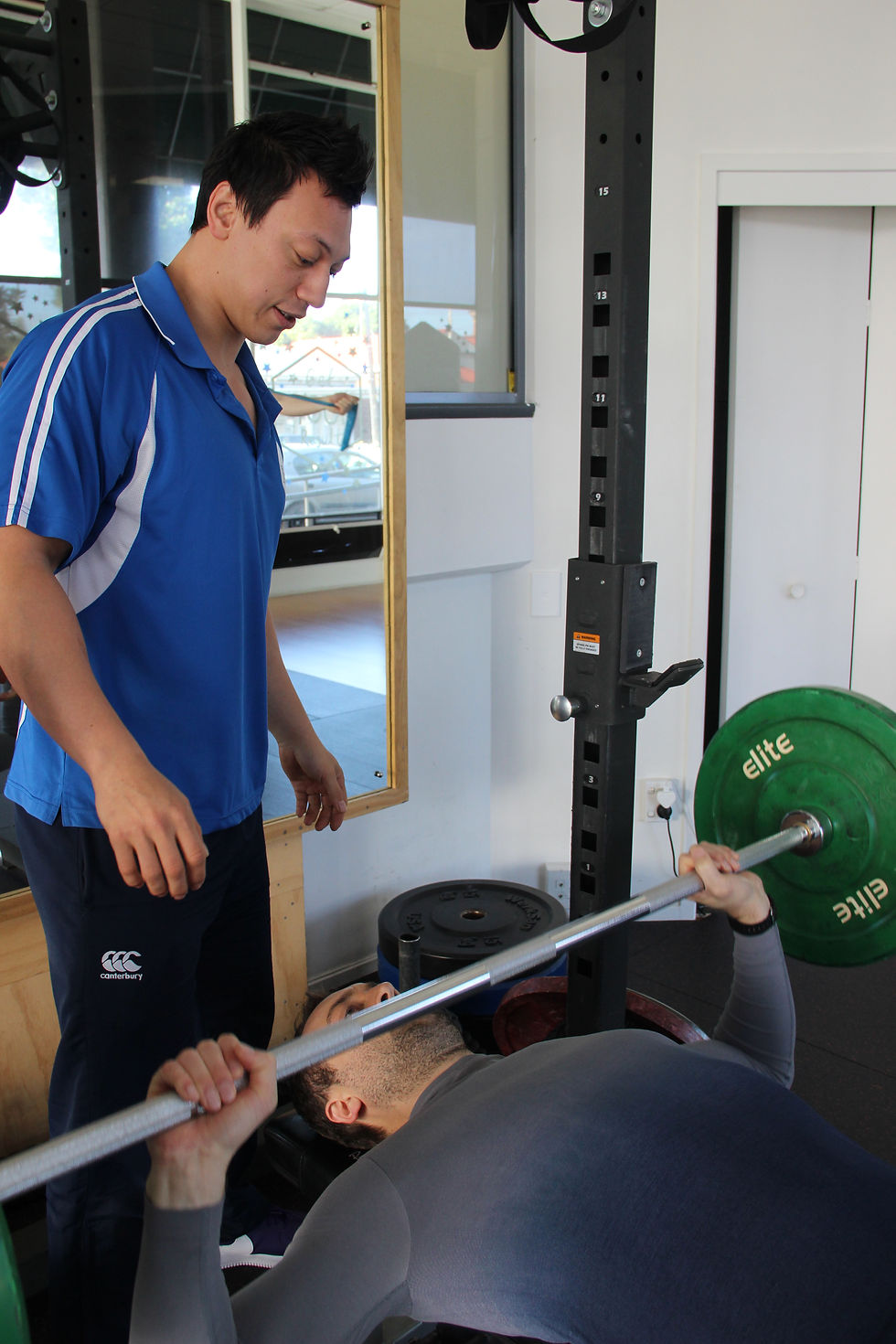
In training, the most popular ways of figuring out training effort are RPE - Rating of Perceived Exertion, and RIR - Repetitions in Reserve.
RPE is a scale of 1-10 for how ‘hard’ you feel that set was, taking into account how many reps you think you could’ve done, and how you’re feeling on the day. So a rating of 8 out of 10 is fairly high, and proposes that it was a tough set, but you could’ve got two more complete reps of the weight you are using.
RIR is simplified to looking at reps in reserve only - in this example, RIR 2 would mean that you had 2 reps in reserve, and could have completed those two reps with a big effort and push. RIR is strictly focused on repetitions remaining… RPE includes taking into account how you feel on the day.
When we use RPE and RIR, we are working on going to complete technical failure. That means trying to rank the set based on keeping the form similar to how you’ve performed other reps. If you put RIR 2, that’s 2 reps in the tank with decent form, not 2 reps but causing yourself to fall over and collapse afterwards, needing a 5 minute lie down.
As a coach, I like to use RPE, because I want people considering their personal readiness that day - did you sleep well, do you have aches or soreness etc. However, it can take some getting used to and adaptation with each member to understand better how they rate their exertion levels. RPE still focuses on the set itself, but allows the load to be adjusted on the day. RIR is simpler as it’s a steadfast “I could’ve got this number of reps”.

What should a productive set feel like?
The final reps are harder than the first reps.
The weight has slowed down (eg in a squat the bar is slower to come up).
You need to concentrate and focus on maintaining position.
You feel your heart rate is rising.
Sometimes you feel your muscles working more (this is largely dependent on the exercise and the person).
Signs a set has gone too far:
Technique has changed dramatically in order to get the final reps out.
Range of motion has shortened considerably.
You use more momentum or ‘body english’ (swinging the weights).
Do I need to train to failure?
This is a nuanced question, but overall, the answer is almost all of the time, no, you don't. As explained in my previous blogpost (Stop chasing fatigue, start chasing progress), training to failure can be helpful in some circumstances, or even in short term protocols, but regularly taking every set to failure will start to create more fatigue and can affect the quality of later sets and even future sessions. The science says that strength can improve across a relatively wide range of effort levels, including sets stopped several repetitions before failure. If you are training for size increases, the recommendation is to go closer to failure, usually within 2 reps. But for strength training and overall health, you don’t need to be as close to failure, 3-4 reps out is fine. The ‘effective reps’ hypertrophy model suggests that when you go to failure, the final 5 reps in the set are the ones providing the most stimulus. So, training within roughly 5 good repetitions to failure means that you have your bases covered.
Research has shown that there is a continuous ‘scale’ of fatigue. For hypertrophy, size based training, sets become more stimulating as they are taken closer to failure. The exact dose-response is uncertain. For strength based training, proximity to failure is much less important, as strength gains are more heavily dependent on load used, technique, total volume of training and progressive overload. Heavier loads are particularly useful for maximal strength because they provide specific practice lifting heavy weights. However, lighter loads can still build muscle when taken sufficiently close to failure.
In number terms - if you are training for size - aim for 1 to 3 RIR.
If you are training for strength, aim for 3 or 4 RIR.
The final thing to mention is that not all exercises are equal - pushing a heavy squat to total failure is much more taxing on the body, and would likely lead to more extreme form breakdown, as opposed to an isolated movement like a triceps or cable pushdown. As we are all different, people have different strength potential and different risk factors with training some muscles or body parts. This is where good coaching comes in, as it’s important to consider the overall picture (what other exercises you are doing, what muscles are being worked) and the nuance of each situation for each person. When I'm working with members at The Active Lifestyle in person or online, we are considering exactly how each set moved and where potential limitations are, so as to provide the right dose for improvement.



Comments